History of St Yeghiche Church
Saint Yeghiche Armenian Church, previously known as the church of Saint Peter, is one of the most prominent churches in London, with an architectural style that encompasses the grandeur of an exquisite English Gothic church. This is heralded by its elaborate bell tower, soaring spire crowned with the sign of Christ, carved pointed arches and stained-glass windows which portray the biblical narratives transmuted into sacred scenes and relics of the saints and prophets.
The serenity and splendour of the church interior speak elegantly of the glory of God and the faith of the church. In every part of the church there are symbols to be understood and hints to the work of God’s grace in our lives. Within its portals the faithful are inspired by its beauty and the scale of the building, which is testimony to the vision of the skilful architects and artists.
The foundation stone of the church was laid in 1867 and was consecrated as an Anglican Church and solemnly dedicated to the glory of Saint Peter, the rock of faith. Much of the history of the church speaks of the various schemes and internal changes and beautifications undertaken over the span of the 20th century. Among other pious memorials within the church is the jewel-like small chapel of the Holy Spirit erected in 1907. The exquisite decorations and authentic Gothic feel of the chapel make it the most inspiring, uplifting and beautiful spot within the church.
The last Anglican Church service was held at Saint Peter’s in January 1973, after which the church was leased to the Armenian Community and Church Council of Great Britain (ACCC). In 1998 the church underwent one of the most comprehensive restoration programmes and was restored to its original beauty. On 10th June 2001, the Supreme Patriarch Catholicos of All Armenians re-consecrated the church to the glory and praise of the 5th century Armenian Church Holy Father Saint Yeghiche; and as a memorial to Mr Yeghiche Manoukian, the beloved father of the church benefactors Mr and Mrs Vatche Manoukian.
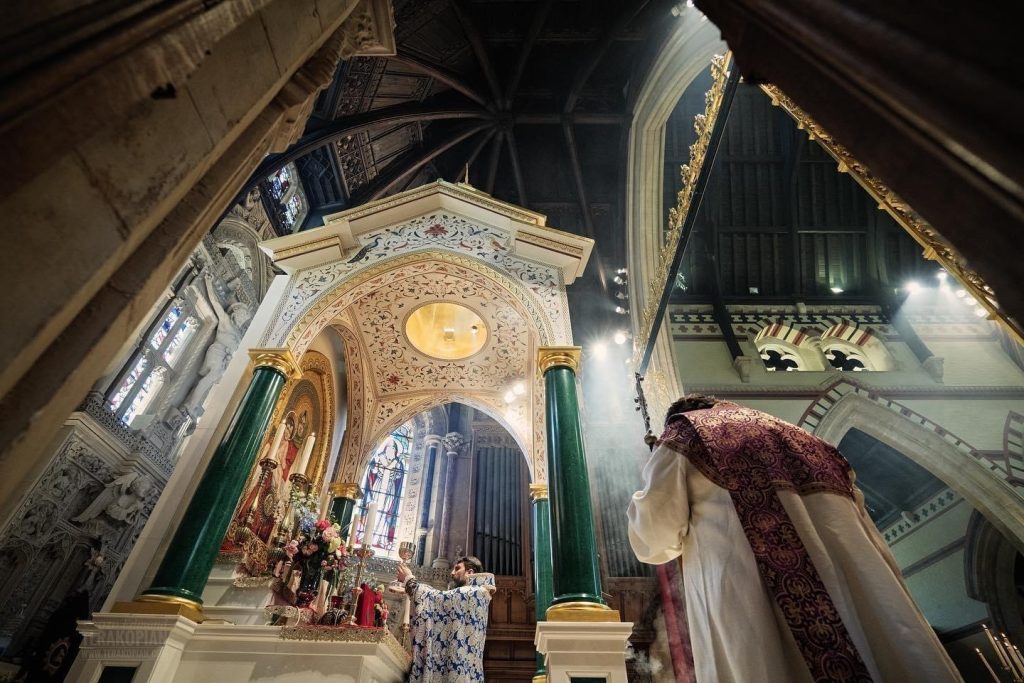
The soaring architecture of the Holy Altar at Saint Yeghiche church forms a majestic background to celebrate the Divine Liturgy, which is the principal and most privileged act of worship for Armenians. Music and Religious Hymns are sung to impart a spiritual, disembodied and heavenly background to the Holy Sacrifice of the Divine Liturgy.
Our Patron Saint – St. Yeghiche (415-475 A.D.)
Nightingale, voice of the night, little soul of the roses,
Ghevond Alishan (The Nightingale of Avarayr)
Friend of all mournful hearts that with sorrow are sighing!
Sing, little nightingale, sing me a song from that hillock,
Sing with my soul of Armenia’s heroes undying!
St. Yeghiche was one of the youngest disciples of Sts. Mesrop Mashtots and Sahag Bartev. He is known for his many achievements that have enriched the cultural treasury of the Armenian Nation.
After a short period of study in Armenia, Yeghiche was sent to Alexandria in around 435 for the enhancement of his education. As a student, he was already singled out for his profound knowledge of both the early Hellenistic culture and the teachings of the fathers of the Church.
Upon his return to Armenia, St. Yeghiche became the personal scribe of General Vardan Mamikonian. Together with Vardan and his soldiers, Yeghiche was involved in the famous battle of Avarayr in AD 451. He soon composed a book titled ‘A History of Vardan and the Armenian War’ in which he beautifully narrated the courage of the Armenian warriors and their determination to preserve their Christian Armenian identity. Inspired by this, St. Yeghiche wrote his famous phrase, “Death not understood is death; death understood is immortality”, which soon became a motto for many soldiers of the land of Armenia. He was named ‘the Nightingale of Avarayr’ by a prominent 19th-century poet and historian, Ghevond Alishan, who dedicated an entire poem to St. Yeghiche and the other holy martyrs of Avarayr.
After the invention of the Armenian alphabet by St. Mesrop Mashtots, when all the tools were provided for the creation of Armenian literature, the holy translators of the 5th century started translating the Bible and the works of the fathers of the Church. Based on these translations, many of the disciples of Mesrop Mashtots and Sahag Bartev wrote their own works, thus laying the foundation of the unique Armenian literature.
When the war with the Persians was over, St. Yeghiche embarked on a profound study of the Holy Scripture and as a result of his studies, he composed commentaries on Genesis, Joshua, Judges, etc. He also produced some other outstanding works of both pastoral and doctrinal nature, such as ‘On the Feast of the Baptism of Christ’, ‘On the Feast of Transfiguration’, ‘On the Lord’s Prayer’, ‘On Judgment and the Second Coming’, ‘On Remembering the Dead’, etc. These works were translated into English to commemorate the 25th Anniversary of St Yeghiche Armenian Church’s consecration.
The oldest extant manuscript containing St. Yeghiche’s ‘History of Vardan’ is dated to the 12th century. The two best editions of this work were published first, in 1826 in Venice by the Mechitarist fathers, and the second, in 1957 in Yerevan by Y. Ter-Minasian.
Being acquainted with the works of the early authors of the church and using their works as a base for his own research St. Yeghiche elevated the studies of the Bible and Christian tradition in Armenian to a whole new level. In his commentaries as well as pastoral works St. Yeghiche has shown his extremely high intellect and the in-depth knowledge of the main theological traditions of the time. Alongside Armenian, many other languages, e.g. Greek, Syriac, Persian etc., were taught in the schools established by St. Yeghiche.
Every year the Armenian Apostolic Holy Church commemorates St. Yeghiche together with the other Holy Translators of the Church. His feast falls on the Saturday preceding the fifth Sunday of the Holy Cross.
V. Rev. Fr. Garegin Hambardzumyan